

In the second half of extra time during Sunday’s World Cup final against Argentina, Spain demonstrated their tactical adaptability. Despite Argentina‘s aggressive play and attempts to block striker Mikel Oyarzabal, Spain adjusted their approach, particularly after substitutions made by coach Luis de la Fuente.
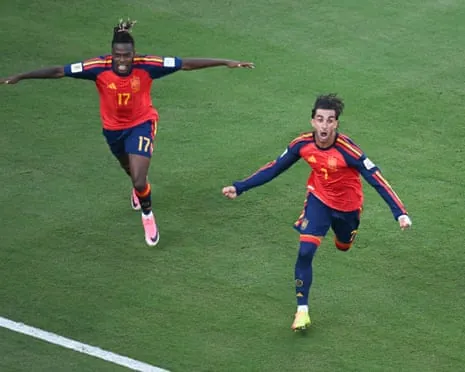
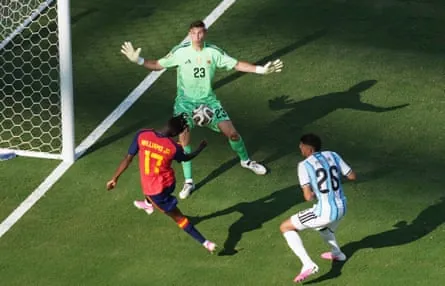
After the 62nd minute, Spain brought on fresh players, seeking new avenues for attack. This strategic shift was evident when Pedro Porro, playing at right-back in the 106th minute, delivered a cross. Nico Williams, a 24-year-old winger, connected with the ball, heading it into the path of fellow second-half substitute Ferran Torres.
Williams’s contribution was particularly notable given his tournament experience. He had spent more time on the sideline than he might have preferred due to a groin strain and hamstring issues from the La Liga season, followed by an adductor injury in the group stage finale against Uruguay. Despite not starting any games in this World Cup, his 45-minute appearance against Argentina was his longest of the tournament, offering a new dynamic compared to the winger he replaced, Álex Baena.
Torres, like Williams, entered the match with the intention of exploiting Argentina‘s defensive strategy. While Oyarzabal had been crucial for Spain’s possession-based play, Argentina‘s setup aimed to prevent him from getting close to goal. Torres, with his finesse and off-ball movement, provided a different threat, and his fresh energy allowed him to maintain sharpness against a tiring Argentinian side. His run went unchecked, leading to a significant moment in the match.
A Family’s Journey and Dedication
Following the final, Nico Williams shared an emotional moment, handing his medal to his mother, María Williams, in the stands. This gesture highlighted the profound journey of his family. María and Félix Williams, Nico’s parents, migrated from Ghana in the 1990s, facing numerous challenges in their pursuit of a better life. Their arduous journey included crossing the Sahara Desert on foot, an experience that left Félix with permanent foot damage, a detail Nico reportedly learned when he was 18.
Upon reaching Melilla, Spain‘s North African enclave, the couple sought asylum, claiming to be fleeing war in Liberia, a decision that allowed them to remain in Spain. They were supported by a Catholic priest, Iñaki Mardones, after whom Nico’s older brother, Iñaki Williams, was named. Both parents worked multiple jobs to support their family, with Félix eventually moving to London to send money home.
Soccer became a central part of the Williams family’s story. Iñaki and Nico both progressed through Athletic Club‘s youth academy, eventually playing together on the first team. Nico has previously acknowledged his brother’s role, stating that Iñaki helped their parents and him, acting as both a brother and a father figure. The brothers’ success is seen as a testament to their parents’ sacrifices, with Nico emphasizing that everything they do is for their parents, who risked their lives for their children’s future.
Iñaki Williams, who represents Ghana internationally, expressed immense pride in his younger brother’s achievement. He shared a tribute on social media, highlighting that Nico‘s success was not just a sporting milestone but also a victory for the immigrant community. Iñaki‘s message underscored that Nico‘s journey has made millions of immigrants proud and has helped many Spaniards empathize with their family’s story, demonstrating that hard work and dedication can lead to success.
Spain’s Collective Approach
Throughout the latter stages of the World Cup, Spain was frequently mentioned as a top team in the tournament. Their collective approach was described as cohesive, with a consistent focus on buildup play. Under De la Fuente, players reportedly gained confidence in their roles, even if it meant less individual spotlight in a tournament often dominated by star players.
This balance is considered rare in modern international soccer, where club teams often have meticulously rehearsed strategies, but national teams typically build around their star players. De la Fuente‘s ability to alter Spain‘s approach during games by introducing substitutes who could occupy similar spaces but interpret their roles differently was a key factor. For instance, Williams‘s approach on the wing was more aggressive than Baena‘s, and Torres helped stretch a shorthanded Argentina. Even Pedri, who came on with Torres, made it more challenging for Argentina with his dribbling ability compared to Fabián Ruiz.
While Argentina appeared to struggle with the conditions, Spain continued to adapt, finding new ways to pressure their opponents. The combination of a well-placed cross, a skillful header, and a timely run into space contributed to their performance.
The Williams brothers are unique in that they are full brothers who played for different national teams in the same World Cup, with Iñaki representing Ghana and Nico playing for Spain.
Nico Williams‘s longest appearance in the tournament was his 45-minute shift against Argentina.
Source: theguardian.com
 Ama Serwah
 Yaw Appiah
 Kwame Ofori