
Introduction
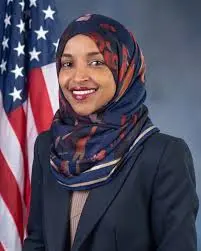
Ilhan Omar has emerged as one of the most influential voices in contemporary American politics. As a member of the U.S. House of Representatives representing Minnesota’s 5th congressional district, she has drawn national attention not only for her policy advocacy but also for her groundbreaking identity as one of the first Muslim women elected to Congress. Omar’s role is crucial in the ongoing discourse on immigration, social justice, and representation for underrepresented communities.
Early Life and Political Journey
Born in Mogadishu, Somalia, in 1982, Omar and her family fled the civil war, eventually seeking refuge in the United States in the mid-1990s. Omar’s immigrant experience shaped her views on social justice and equity, leading her to pursue a career in public service. She earned her degree from North Dakota State University and began her political career as a community activist before entering local politics.
In 2016, she made history by becoming the first Somali-American legislator elected in the United States when she joined the Minnesota House of Representatives. Her triumph was a significant milestone not only for her community but also for broader representation in American politics, paving the way for her election to the U.S. Congress in 2018.
Current Political Focus and Challenges
Omar’s tenure in Congress has been marked by her fierce advocacy for progressive policies, including healthcare reform, climate action, and racial justice. She is a prominent member of the ‘Squad’, a group of progressive Democratic Congresswomen who advocate for transformative change. In recent developments, she has been vocal about foreign policy, especially concerning U.S.-Israel relations and immigration reform—issues that have sometimes sparked controversy and polarized opinions among constituents and the broader electorate.
Additionally, her outspoken stance has drawn not only support but also criticism, leading to significant public discourse about political discourse and the limits of free speech in America. Recent polls indicate that while Omar has a solid base of support in her district, there are factions that oppose her viewpoints, which could impact her re-election prospects in 2024.
Conclusion
Ilhan Omar’s journey from a refugee to a U.S. Congresswoman exemplifies the evolving nature of American politics and the increasing call for representation from diverse backgrounds. Her advocacy continues to challenge the status quo and spurs conversations around critical issues facing the nation. As the 2024 election draws near, Omar’s impact and the challenges she faces will significantly influence discussions about diversity, representation, and the future of progressive politics in the United States.
 Yaw Appiah
 Evelyn Mensah
 Kwame Ofori