
Introduction
The violation of national airspace by military jets is a significant issue that can escalate tensions between countries and affect regional security. Recently, reports have emerged regarding incidents involving Russian jets breaching Estonian airspace, raising alarms not only within Estonia but also among NATO allies. These occurrences highlight the fragile security situation in Eastern Europe, particularly in the wake of ongoing conflicts and strained relationships following Russia’s actions in Ukraine.
Details of the Incidents
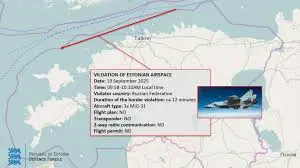
In recent weeks, Estonian defence officials reported multiple instances of Russian military aircraft entering their airspace without prior notification. On October 15, 2023, the Estonian Ministry of Defence stated that Russian fighter jets were detected making an incursion into Estonian airspace. This incident not only violates international protocols regarding flight safety and communication but also serves as a reminder of the heightened military activity in the Baltic region.
Estonia, a NATO member, has expressed its concerns and called for immediate action. They reported that the Russian jets were intercepted by NATO’s air policing mission stationed in the Baltic region. The presence of NATO in Eastern Europe acts as a deterrent against such violations, yet the frequency of these incidents suggests a growing pattern that could lead to a miscalculation or confrontation if not addressed effectively.
Reactions and Implications
The violation of airspace has elicited strong reactions from both Estonian officials and NATO representatives. The NATO Secretary-General remarked on the importance of respecting national borders and affirmed the alliance’s commitment to ensuring the security of its members. EU officials also weighed in, calling for diplomatic solutions while remaining vigilant against further provocations.
These incidents have broader implications for regional stability. As military tensions in the Baltic Sea increase, neighbouring countries are left to grapple with the question of how best to respond. The potential for escalation remains a concern, especially given the complex nature of military engagements and international relations in this part of Europe.
Conclusion
The recent violations of Estonian airspace by Russian jets underscore not only the ongoing military confrontations between Russia and NATO but also the broader geopolitical challenges faced by the Baltic states. As countries navigate these turbulent waters, the reliance on diplomatic channels and unified responses becomes critical. With the 2023 security landscape continuing to evolve, both political and military leaders will need to remain vigilant and proactive to ensure that airspace violations do not lead to more severe conflicts in the future.
 Kwame Ofori
 Ama Serwah