
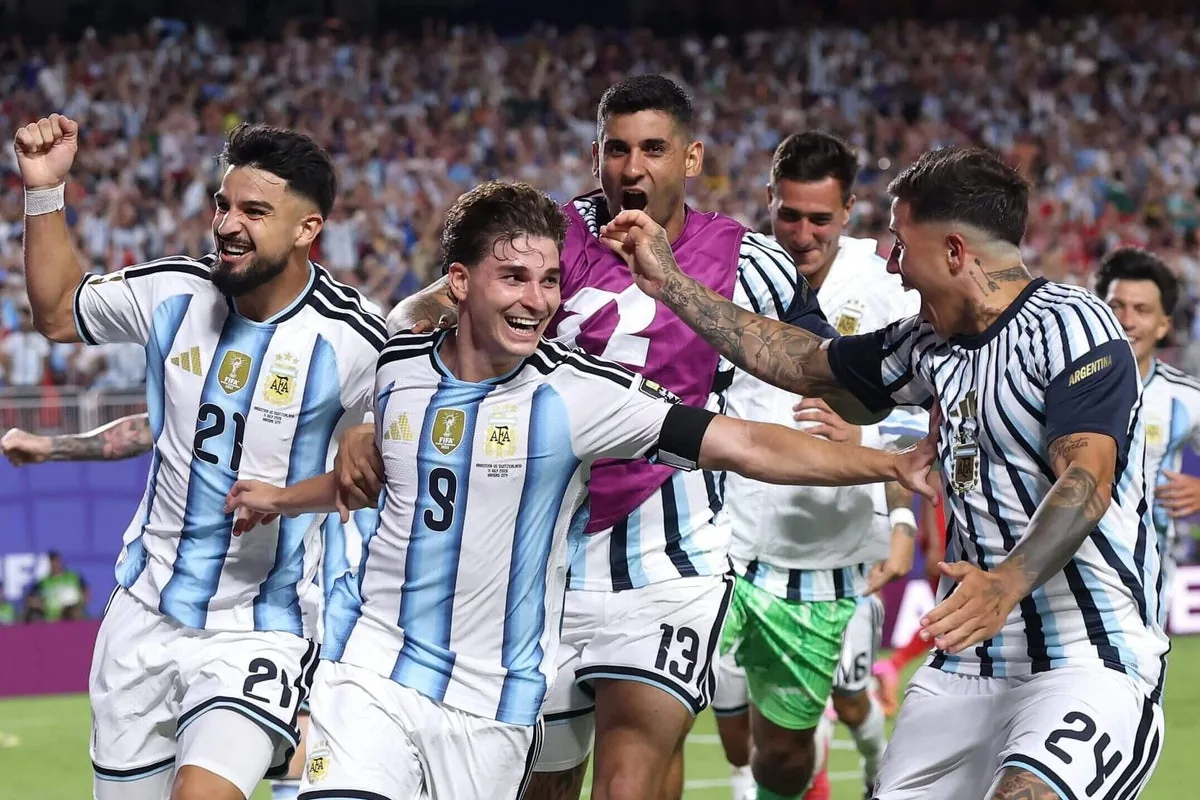
Argentina has secured a spot in the World Cup semi-finals, overcoming Switzerland in a 3-1 victory marked by a significant red card incident. The match saw a late surge from Argentina, with goals in extra time sealing their progression.
The decisive goal came in the 112th minute from Julian Alvarez, who curled a shot into the top corner from outside the penalty area. This was followed by a third goal from Lautaro Martinez, effectively ending Switzerland’s challenge. Argentina is now set to face England in the semi-finals on Wednesday.
Controversial Red Card Incident
A major talking point of the match was the sending off of Switzerland’s Breel Embolo. This occurred moments after Dan Ndoye had equalized Alexis Mac Allister’s opening goal for Argentina. Embolo received a red card following a VAR review for ‘mistaken identity’.
Initially, it appeared that Argentina’s Leandro Paredes had committed a foul on Embolo, leading Portuguese referee Joao Pinheiro to show Paredes a yellow card. However, VAR intervened after reviewing replays that suggested there was no contact and Embolo had simulated a foul.
The review led to the official withdrawing the booking for Paredes and instead showing a yellow card to Embolo. Since Embolo had already received a yellow card in the first half for fouling Paredes, this second booking resulted in a red card, leading to his dismissal from the game.
Under new rules introduced for the World Cup, reviewable decisions now include mistaken identity when a referee shows a yellow or red card but penalizes the wrong player of either team. This allows for the identity of the attacker to be reviewed if the referee misidentifies the player who committed the offense. Pinheiro’s decision to reverse his original call was in line with these rules.
Argentina’s Performance and Messi’s Contribution
For the first time in this World Cup, Lionel Messi did not score, with Julian Alvarez taking center stage. Alvarez’s curling strike in extra time is considered a contender for goal of the tournament. Messi, however, contributed significantly by providing his 10th World Cup assist, setting up Mac Allister’s opener. Each of Messi’s World Cup assists has been for a different goalscorer, a streak that began in 2006.
Despite their win, Argentina’s performance was described as chaotic, particularly after taking an early lead. They went nearly 90 minutes without another shot on target between Mac Allister’s goal and a late effort from Lisandro Martinez. Switzerland’s goalkeeper Kobel was active, making saves from Ndoye and Embolo, as well as a long-range strike from Granit Xhaka.
Argentina has demonstrated a strong scoring record in the World Cup, having scored in 15 consecutive World Cup games. They also set a new World Cup record for the longest sequence of scoring multiple goals in the competition’s history, surpassing Uruguay’s record from 1930 to 1954.
The upcoming semi-final against England promises to be a compelling match, given the historical rivalry between the two nations. Messi will be facing England for the first time in his career. The Swiss performance against Argentina, which saw them create numerous problems for the defending world champions, suggests that England will have opportunities to challenge Argentina’s defense.
Switzerland’s coach Murat Yakin expressed pride in his team’s passion despite playing with one man down. Argentina’s journey in the knockout stages has not been straightforward, and while they possess undeniable star power, their defensive frailties were evident against Switzerland.
Embolo’s red card for simulation marked the first instance of a player being sent off under the new mistaken identity rule in this World Cup. The rule allows for a decision to be changed if a player is booked or sent off but the foul was committed by the opposition team. An earlier application of this rule involved USA defender Tim Ream, whose yellow card was rescinded, and Miguel Almiron was booked for simulation instead.
The match concluded with Argentina securing a 3-1 victory, setting up their semi-final clash with England on Wednesday.
Source: nytimes.com
 Ama Serwah
 Yaw Appiah
 Evelyn Mensah