

Record-Breaking Ad Volume
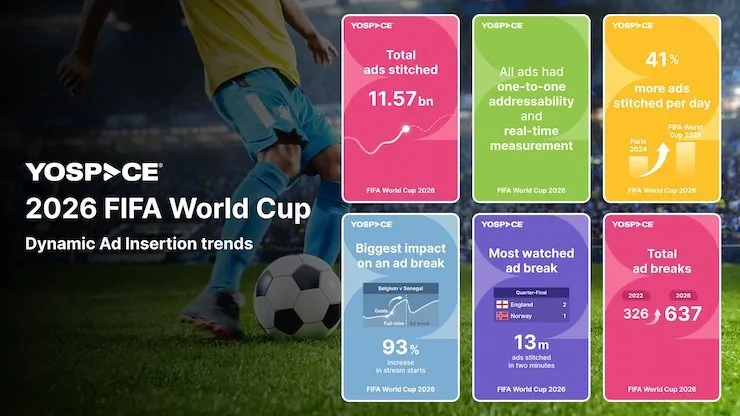
The recent FIFA World Cup in 2026 saw a significant increase in addressable advertisements, with technology provider Yospace stitching 11.57 billion one-to-one ads into live video streams. This translates to an average of 297 million advertisements per day throughout the 39-day tournament. This volume represents a substantial rise compared to other major global events, with the Paris 2024 Summer Games experiencing 41 per cent fewer advertisements stitched daily.
The data, collected from Yospace’s global network of broadcasters and distributors, highlights a broader trend: viewers are increasingly moving towards app-based channels on connected televisions, away from traditional linear services. Broadcasters are adapting by focusing on monetizing their online streaming services more effectively, particularly through the use of Dynamic Ad Insertion (DAI) for online traffic.
Tournament Structure Boosts Ad Opportunities
The 2026 edition of the FIFA World Cup introduced several changes that created additional advertising opportunities. The tournament featured 16 more teams than the 2022 event, resulting in 40 extra matches where advertisements could be sold. Furthermore, the introduction of a three-minute hydration break in each half provided another avenue for ad-supported rights holders to insert commercials.
One of the busiest advertising periods occurred at the start of half-time during the England versus Norway quarter-final match. During a two-minute window, Yospace stitched 13 million one-to-one addressable advertisements. This event underscored the need for DAI systems and associated advertising technology to scale rapidly.
Across the entire tournament, there were 637 advertising breaks, including hydration breaks, compared to 326 in 2022. This increase was attributed to both the higher number of matches and more advertising breaks per match, as well as the nature of play. Hydration breaks, in particular, proved valuable, with Yospace recording an audience drop-off rate of only 0.4 per cent for some matches during these breaks, significantly lower than the 16.82 per cent observed during half-time.
Audience Engagement and Ad Effectiveness
Audience engagement during key moments also impacted advertising effectiveness. For instance, when France was awarded a penalty against Morocco in the quarter-finals, the subsequent Video Assistant Referee check led to a 37 per cent increase in stream starts between the penalty award and Kylian Mbappé taking the kick. A hydration break followed shortly after his miss.
Earlier in the tournament, Belgium’s comeback from a 2–0 deficit against Senegal in the Round of 32 generated a 93 per cent increase in stream starts within two minutes. The audience continued to grow until the final whistle and the subsequent advertising break. Typically, the final whistle causes an audience drop-off of approximately 50 per cent within minutes. However, Belgium’s late goals meant the drop-off was only 11 per cent, benefiting the advertising break that followed.
Tim Sewell, CEO of Yospace, noted that the 2026 FIFA World Cup showcased the substantial scale of ad-funded streaming today. He emphasized the importance of a quality experience and seamless advertising during moments when entire nations are watching. The data suggests that live streaming has significant growth potential, requiring robust Dynamic Ad Insertion technology to meet future demand.
A study indicates that 40 per cent of viewers continue watching an ad even if it repeats. The study also found that repetition can positively affect brand awareness, with 44 per cent of respondents agreeing. The World Cup also showed that soccer matches, traditionally having less standard TV advertising inventory compared to sports like football, basketball, or baseball, now benefit from the added hydration breaks.
The attention score for Fox’s World Cup coverage was 23 per cent higher than the average for Fox programming. This score considers the interruption rate, which is the percentage of ad views that end prematurely due to viewer disengagement. Data from Automatic Content Recognition (ACR) on smart TVs and set-top boxes tracks second-by-second viewer behavior during commercials. However, there is a threshold for ad frequency, typically around four to five repetitions, beyond which viewer fatigue tends to set in.
Yospace, founded in 1999, has focused on server-side ad insertion, demonstrating the technology with ITV in 2012 and subsequently deploying it internationally. The company now manages over 2,000 live channels and typically stitches over 10 billion advertisements monthly. In 2019, RTL Group acquired Yospace for a reported consideration of €19 million.
The expanded World Cup, with 104 matches compared to 64 in 2022, provided more opportunities for personalized advertising. ITV, a broadcaster in the United Kingdom, described the competition as its most lucrative sporting event, selling packages to 220 advertisers, with 70 appearing in football coverage for the first time. ITV carried 19 more matches than in 2022, with more games in peak time, and enabled dynamic advertising insertion for live streams on ITVX.
The World Cup demonstrated that personalized advertising can now be delivered to large streaming audiences with the same simultaneity and resilience expected from conventional broadcasting.
Source: content-technology.com
 Ama Serwah
 Yaw Appiah
 Kwame Ofori
 Evelyn Mensah