
Introduction
The recent discovery of interstellar comet 3I Atlas has captivated astronomers and space enthusiasts around the world. This celestial body, known as an interstellar visitor, has sparked debates regarding the origins of our solar system and the nature of cosmic phenomena. Its significance lies in providing scientists with a unique opportunity to study materials that may have formed outside our solar system, shedding light on the universe’s vast history.
What is Comet 3I Atlas?
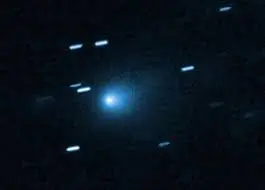
Interstellar comet 3I Atlas, also known as 3I/2019 Q4, was first detected on 19 December 2020 by astronomers using the Pan-STARRS 2 telescope in Hawaii. The comet is classified as a hyperbolic comet, indicating that its trajectory is not bound by the gravitational pull of the Sun, meaning it originated from another star system. Preliminary observations suggest that 3I Atlas shows characteristics consistent with typical comets, such as a bright coma and a trailing tail.
Key Observations and Findings
The comet made its closest approach to the Sun in early 2021, allowing researchers to conduct detailed studies. Spectroscopic analysis revealed a composition rich in organic molecules, minerals, and ices, suggesting that it holds clues about the building blocks of life and the early solar system. The comet’s speed and trajectory confirmed its interstellar origin, placing it on a path that will take it beyond the influence of our solar system.
Significance of 3I Atlas in Space Research
The study of interstellar comets like 3I Atlas is crucial for understanding both the solar system’s formation and the possible evolution of other planetary systems. According to astronomers, these objects act as time capsules, preserving information from the distant past of the universe. The findings from 3I Atlas may provide insights into how stars and planets form, as well as how organic materials are distributed throughout the galaxy.
Conclusion
The interstellar comet 3I Atlas represents a remarkable opportunity for scientific discovery and exploration. As observational technology advances, future studies may uncover even more about interstellar objects and their impact on the understanding of our own solar system. This comet not only enriches our knowledge of the cosmos but also ignites the curiosity of scientists and the public alike, promising more significant revelations as research continues.
 Yaw Appiah
 Evelyn Mensah
 Ama Serwah
 Kwame Ofori